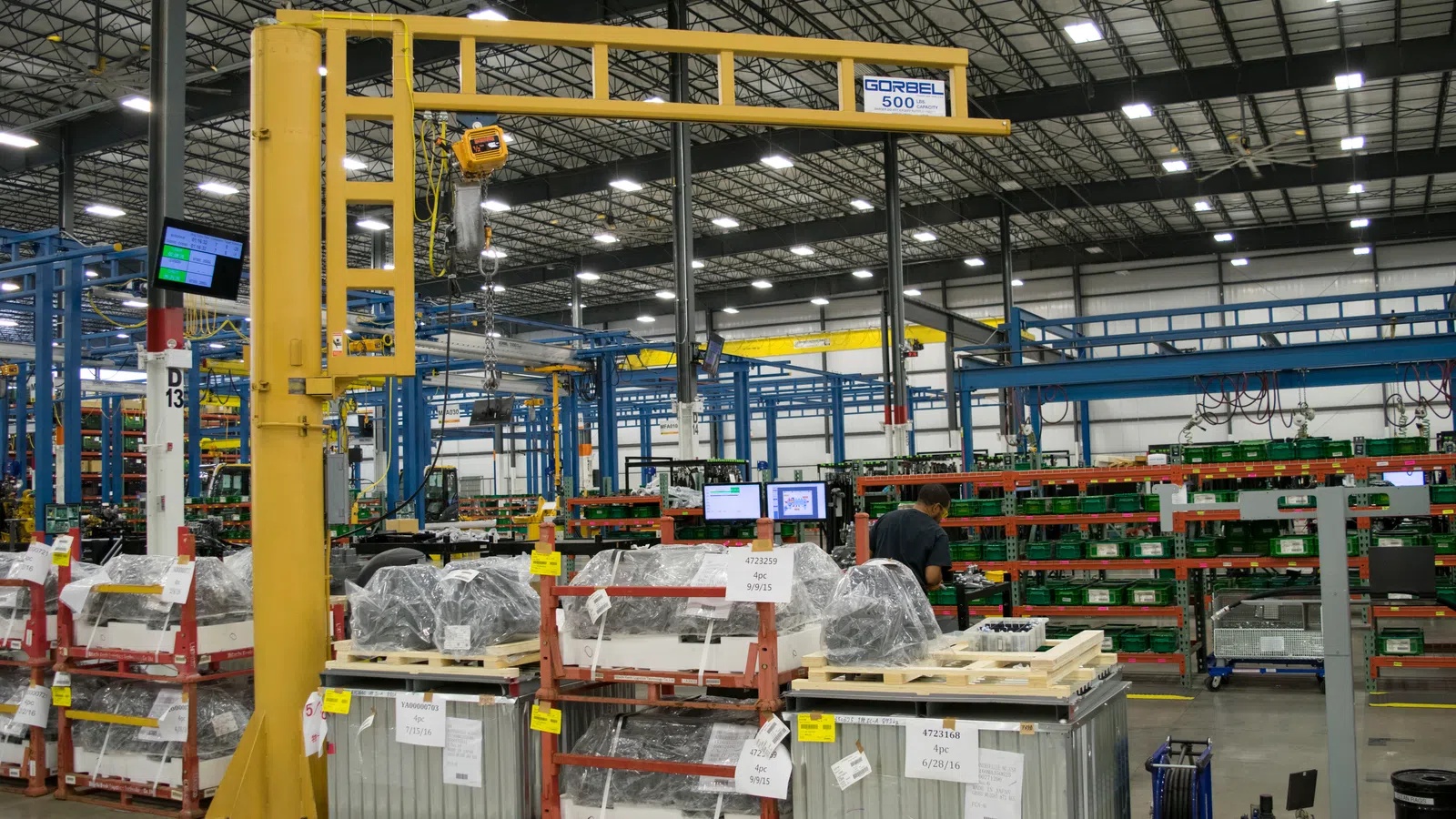
Free Standing Jib Cranes in Atlanta, GA
360° Lifting at One Station.
Full 360° jib cranes on their own mast, with your slab verified first and installed by our own crews across the Southeast.
Plan Your Jib Crane
What a Free Standing Jib Crane Is
In 30 Seconds
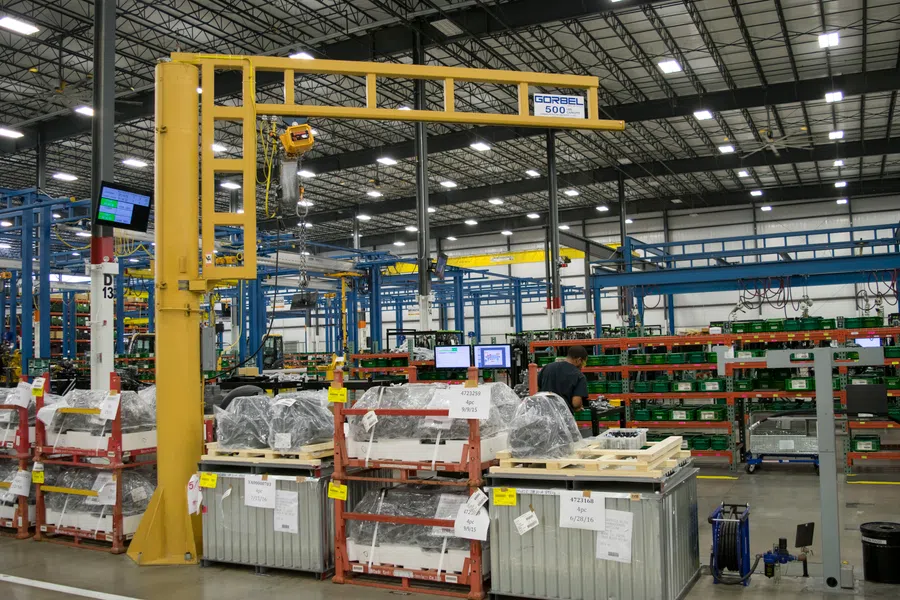
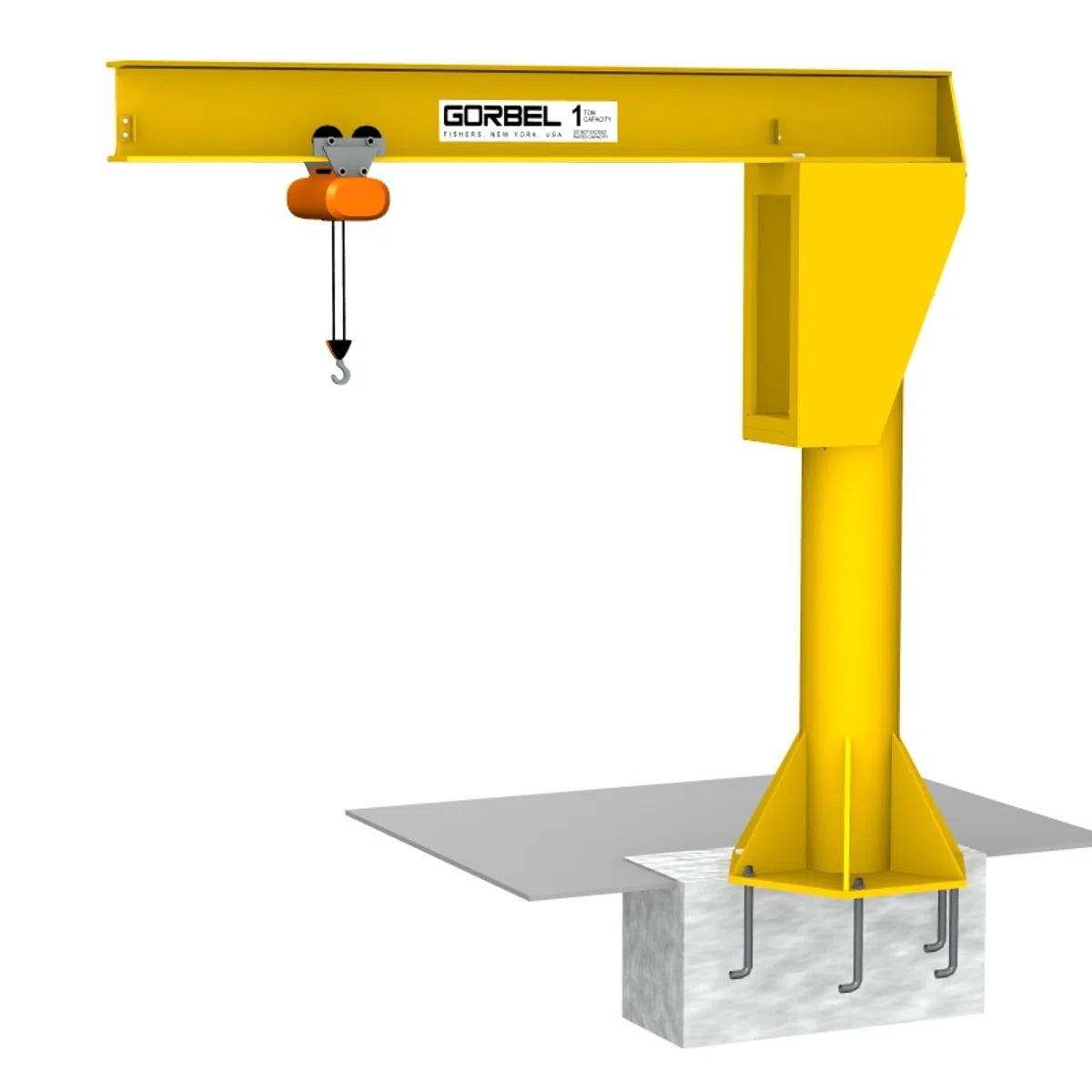
A free-standing jib crane has a vertical mast anchored to the floor, a rotating horizontal boom, and a trolley-mounted hoist that travels the boom, covering a circular work area around one point.
What sets it apart is the mount. Column- and wall-mounted jibs rely on existing structure and rotate only about 200° before hitting it. A free-standing jib, unobstructed, rotates a full 360°.
That gap matters in practice: a 200° jib covers a machine and staging area; a 360° jib covers those plus whatever's behind the operator too.
- What it is. A jib crane on its own mast, anchored to the floor rather than mounted to a column or wall.
- The advantage. 360° rotation, versus about 200° for column and wall-mounted units. Nothing blocks the swing.
- What it needs. Reinforced concrete, generally at least 6 inches, verified before anchoring.
- What it does not need. Anything from your building structure.
Foundation and Installation
Requirements
This is the part that determines whether the project is simple or not.
Where Free Standing Jib Cranes Go In
Placement Scenarios
- Leased buildings. No modification to the landlord's structure
- Weak or unknown roof structure. Common in older facilities where nobody has drawings
- Mid-floor stations. Machines that are not near a column or a wall, which is most of them
- Where 360° matters. Loading a machine and setting the part on a cart behind you, in one motion
- Relocatable installations. Unbolt, patch, re-anchor. Not trivial, but far easier than removing a ceiling-mounted workstation crane
Laid Out in AutoCAD Before Anything Is Fabricated
Design Process
Every crane project starts with a site visit and an AutoCAD layout showing the crane against your actual floor - columns, machine envelopes, walk paths, and forklift aisles. You see the coverage arc before anything is built.
Our crews do the mechanical installation. See a free-standing crane we installed in one day.
Frequently Asked Questions
FAQ
How thick does my slab need to be?
Generally at least 6 inches of reinforced concrete, but thickness alone does not answer it - reinforcement, subgrade, and existing joints matter too. We verify during site review, and where it is inadequate we design a footing.
Can it really rotate 360 degrees?
Yes, on floor-mounted units. Column and wall-mounted jibs are limited to roughly 200° by the structure they are attached to.
Can a free standing jib be moved later?
Yes, with effort. Unbolt the base, patch the anchors, re-anchor at the new location. Far simpler than relocating anything that hangs from the roof.
How much can it lift?
Enclosed track jib cranes typically handle up to about 1,000 lbs, with I-beam jib configurations available to considerably more. Above that, look at overhead crane systems.
Send Us the Station and the Load
Start a project
Footprint, available height to the lowest obstruction, and what goes on each level.